


s the Suction Inlet under pressure or by gravity and as the ROTOR 1 turns within the flexible rubber STATOR 2 forming tightly sealed cavities 3 which moves the Liquid toward the Discharge Outlet. Pumping action starts the instant the ROTOR turns. Liquid acts as the lubricant between the pumping elements.
[hr][/hr] Pseudoplastic: The property of a fluid whose viscosity increases slowly with rate of shear.
For more information see[link Point to another website Only the registered members can access]
[hr][/hr] Pumps as turbines (PAT): Pumps used in reverse to act as turbines.
For more information see[link Point to another website Only the registered members can access]
[link Point to another website Only the registered members can access]
Radial flow pump: refers to the design of a centrifugal pump for medium head and medium flow or high head and low flow. The value of the [link Point to another website Only the registered members can access]
[link Point to another website Only the registered members can access]
[hr][/hr] Radial vane pump: also known as partial emission pump or vane pump. A frame mounted, end suction, top centerline discharge, ANSI pump designed specifically to handle corrosive chemicals at low flows.
Vane pump
see[link Point to another website Only the registered members can access]
see also [link Point to another website Only the registered members can access]
[hr][/hr] Recessed impeller pump: sometimes known as vortex pump. This is a frame-mounted, back pull-out, end suction, recessed impeller, tangential discharge pump designed specifically to handle certain bulky or fibrous solids, air or gas entrained liquids or shear sensitive liquids.
Recessed impeller pump
see[link Point to another website Only the registered members can access]
see also[link Point to another website Only the registered members can access]
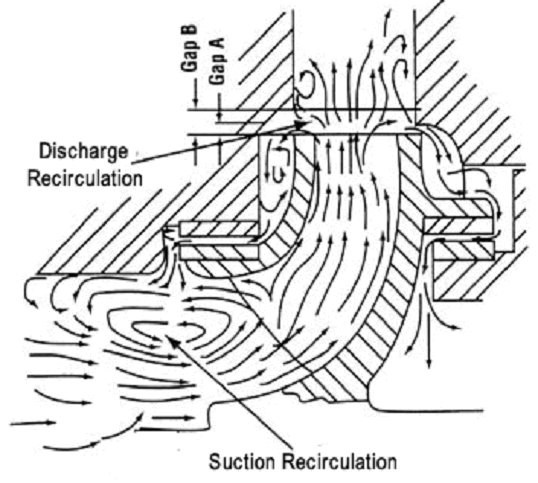
[hr][/hr] Recirculation: at low flow and high flow compared to the flow at the B.E.P. the fluid will start to recirculate or move in a reverse direction at the suction and at the discharge.
It is well established that cavitation type of damage seen on the inlet vanes and not associated with inadequate NPSH can be directly linked to the pump operating in the suction recirculation zone. Similar damage seen on the discharge vane tips can also be associated with pump operation in the discharge recirculation zone.
The suction and discharge recirculation may occur at different points as shown on the characteristic curve below.
[hr][/hr] Regenerative pump: see[link Point to another website Only the registered members can access]
[hr][/hr] Reynolds number: the Reynolds number is proportional to the ratio of velocity and viscosity, the higher the number (higher than 4000 for turbulent flow) the more turbulent the flow and the less [link Point to another website Only the registered members can access]
[link Point to another website Only the registered members can access]
[link Point to another website Only the registered members can access]
[hr][/hr] Rheopectic: The property of a fluid whose viscosity increases with time.
For more information see[link Point to another website Only the registered members can access]
[hr][/hr] Rubber pump liner: see [link Point to another website Only the registered members can access]
[hr][/hr] Screw impeller: The screw centrifugal impeller is shaped like a tapered Archimedes screw. Originally developped for pumping live fish, the screw centrifugal pump has become popular for
many solids handling applications.

for more information see[link Point to another website Only the registered members can access]
see also [link Point to another website Only the registered members can access]
[hr][/hr] Sealless pump: see [link Point to another website Only the registered members can access]




 Reply With Quote

Bookmarks