


The Best of the Internet
Centrifugal pump system tutorial 2
by
, 08-08-2011 at 07:35 AM (2107 Views)
CENTRIFUGAL PUMP SYSTEM TUTORIAL 2
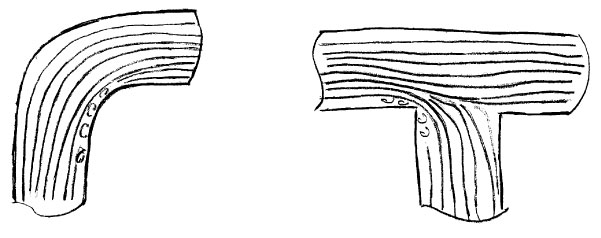
What is friction in a pump system (cont.) Another cause of friction is all the fittings (elbows, tees, y's, etc) required to get the fluid from point A to B. Each one has a particular effect on the fluid streamlines. For example in the case of the elbow, the fluid particles that are closest to the tight inner radius of the elbow lift off from the pipe surface forming small vortices that consume energy. This energy loss is small for one elbow but if you have several elbows and other fittings the total can become significant. Generally speaking they rarely represent more then 30% of the total friction due to the overall pipe length.
Figure 9
[hr][/hr] Energy and head in pump systems
Energy and head are two terms that are often used in pump systems. We use energy to describe the movement of liquids in pump systems because it is easier than any other method. There are four forms of energy in pump systems: pressure, elevation, friction and velocity.
Pressure is produced at the bottom of the reservoir because the liquid fills up the container completely and its weight produces a force that is distributed over a surface which is pressure. This type of pressure is called static pressure. Pressure energy is the energy that builds up when liquid or gas particles are moved slightly closer to each other and as a result they push outwards in their environment. A good example is a fire extinguisher, work was done to get the liquid into the container and then to pressurize it. Once the container is closed the pressure energy is available for later use.
Elevation energy is the energy that is available to a liquid when it is at a certain height. If you let it discharge it can drive something useful like a turbine producing electricity.
Friction energy is the energy that is lost to the environment due to the movement of the liquid through pipes and fittings in the system.
Velocity energy is the energy that moving objects have. When a baseball is thrown by a pitcher he gives it velocity energy also called kinetic energy. When water comes out of a garden hose, it has velocity energy.
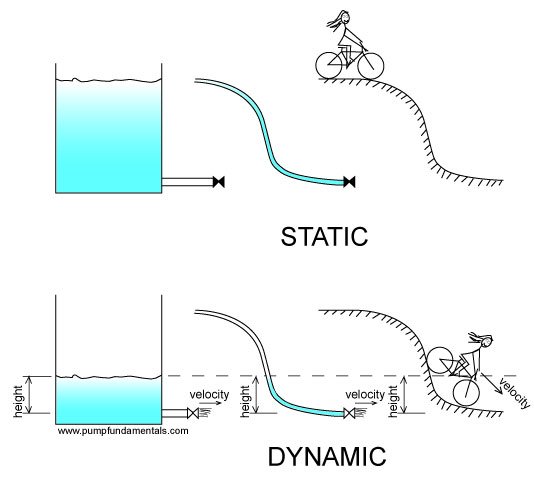
Figure 9a
In the figure above we see a tank full of water, a tube full of water and a cyclist at the top of a hill. The tank produces pressure at the bottom and so does the tube. The cyclist has elevation energy which he will be using as soon as he moves.
As we open the valve at the tank bottom the fluid leaves the tank with a certain velocity, in this case pressure energy is converted to velocity energy. The same thing happens with the tube. In the case of the cyclist, the elevation energy is gradually converted to velocity energy.
The three forms of energy: elevation, pressure and velocity interact with each other in liquids. For solid objects there is no pressure energy because they don’t extend outwards like liquids filling up all the available space and therefore they are not subject to the same kind of pressure changes.
The energy that the pump must supply is the friction energy plus the elevation energy.
PUMP ENERGY = FRICTION ENERGY + ELEVATION ENERGY
Figure 9b
You are probably thinking where is the velocity energy in all this. Well if the liquid comes out of the system at high velocity then we would have to consider it but this is not a typical situation and we can neglect this for the systems discussed in this article.
The last word on this topic, it is actually the velocity energy difference that we would need to consider. In figure 9c the velocities at point 1 and point 2 are the result of the position of the fluid particles at points 1 and 2 and the action of the pump. The difference between these two velocity energies is an energy deficiency that the pump must supply but as you can see the velocities of these two points will be quite small.
Now what about head? Head is actually a way to simplify the use of energy. To use energy we need to know the weight of the object displaced.
Elevation energy E.E. is the weight of the object W times the distance d:
EE = W x d
Friction energy FE is the force of friction F times the distance the liquid is displaced or the pipe length l:
FE = F x l
Head is defined as energy divided by weight or the amount of energy used to displace a object divided by its weight. For elevation energy, the elevation head EH is:
EH = W x d / W = d
For friction energy, the friction head FH is the friction energy divided by the weight of liquid displaced:
FH = FE/W = F x l / W (see Figure 9b)
The friction force F is in pounds and W the weight is also in pounds so that the unit of friction head is feet. This represents the amount of energy that the pump has to provide to overcome friction.

I know you are thinking this doesn’t make sense, how can feet represent energy?
Read More
http://www.egpet.net/vb/showthread.p...573#post176573


Tags:
None

- Categories
- Mechanical
 Email Blog Entry
 Go to Profile
 Mark as Read
