


The Best of the Internet
Pump and pump system glossary
by
, 08-08-2011 at 08:00 AM (2245 Views)
PUMP AND PUMP SYSTEM GLOSSARY
[table]
[TR]
[TD]Absolute pressure: pressure is measured in psi (pounds per square inch) in the imperial system and kPa (kiloPascal or bar) in the metric system. Most pressure measurements are made relative to the local atmospheric pressure. In that case we add a "g" to the pressure measurement unit such as psig or kPag. The value of the local atmospheric pressure varies with elevation It is not the same if you are at sea level (14.7 psia) or at 4000 feet elevation (12.7 psia). In certain cases it is necessary to measure pressure values that are less then the local atmospheric pressure and in those cases we use the absolute unit of pressure, the psia or kPa a.
pa(psia) = pr(psig) + patm(psia), patm = 14.7 psia at sea level.
where pa is the absolute pressure, pr the relative pressure and patm the absolute pressure value of the local atmospheric pressure.
and in the metric system
pa(kPa a) = pr(kPag) + patm(kPa a), patm = 100 kPa a at sea level.
[/TD]
[TD][/TD]
[/TR]
[/table]
[hr][/hr] [table]
[TR]
[TD]Accumulator: used in domestic water applications to stabilize the pressure in the system and avoid the pump cycling on and off every time a tap is opened somewhere in the house. The flexible bladder is pressurized with air at the pressure desired for acheiving the correct flow rate at the furthest point of the house or system. As water is pulled from the tank the bladder expands to fill the volume and maintain the pressure. When the bladder can no longer expand the water pressure drops, the pressure switch of the pump is activated on low pressure, and the pump starts and fills the water volume of the accumulator. The bladder keeps the air from entering into solution with the water resulting in less frequent re-pressurisation of the accumulator.
[/TD]
[TD][/TD]
[/TR]
[/table]
[table]
[TR]
[TD][/TD]
[TD][/TD]
[/TR]
[/table]
Pumps are often sold as a package with an accumulator.
[hr][/hr] Affinity laws: the affinity laws are used to predict the change in diameter required to increase the flow or total head of a pump. They can also predict the change in speed required to achieve a different flow and total head. The affinity laws can only be applied in circumstances where the system has a high friction head compared to the static head and this is because the affinity laws can only be applied between performance points that are at the same efficiency. see affinity laws.pdf
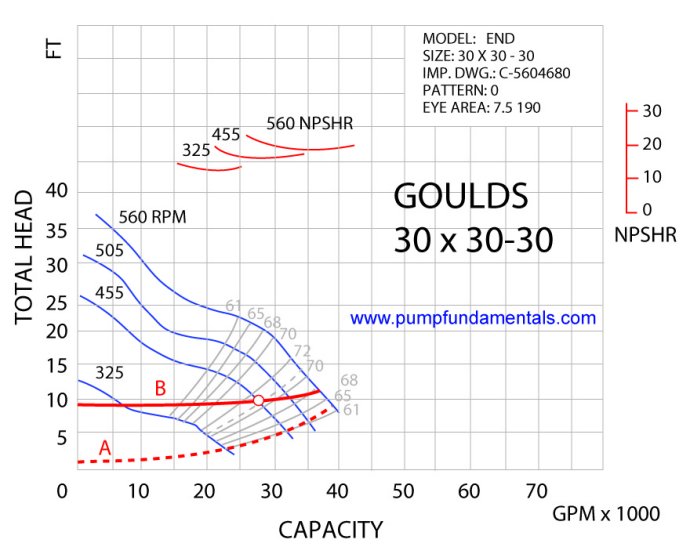
The following figure shows a system that has a friction head (curve A) higher than its static head for which the affinity laws apply, as compared to curve B, a system with a high static head as compared to the friction head where the affinity laws do not apply.
Domain of application of the affinity laws for an axial flow pump.
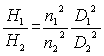
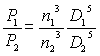
The affinity laws are expressed by the three following relationships where Q is the flow rate, n the pump rpm, H the total head and P the power. You can predict the operating condition for point 2 based on the knowledge of the conditions at point 1 and vice versa.
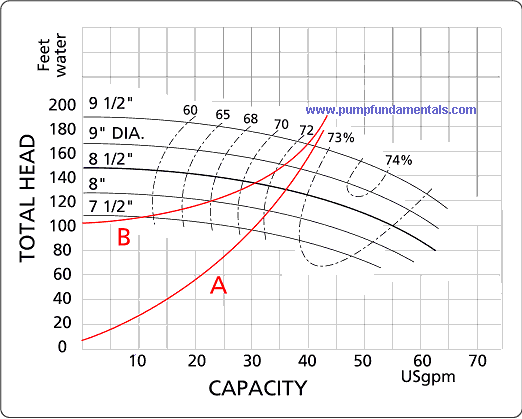
The process of arriving at the affinity laws assumes that the two operating points that are being compared are at the same efficiency. The relationship between two operating points, say 1 and 2, depends on the shape of the system curve (see next Figure). The points that lie on system curve A will all be approximately at the same efficiency. Whereas the points that lie on system curve B are not. The affinity laws do not apply to points that belong to system curve B. System curve B describes a system with a relatively high static head vs. system curve A which has a low static head.
Read More
http://www.egpet.net/vb/showthread.p...ystem-glossary




Tags:
None

- Categories
- Mechanical
 Email Blog Entry
 Go to Profile
 Mark as Read
