


 .
.
Very thanks for Dr. Ove Bratland for offer this Book for free
| [h=Pipe Flow 2: Multi-phase Flow Assurance]2[/h] |
|---|
| The free version of the book is for your personal and non-commercial use only. You may not modify, copy, distribute, transmit, display, reproduce, publish, license, create derivative works from, transfer, or sell any information from the book. Permission to use the book is granted, provided that (1) the copyright notice as well as the 'for non-commercial use only'-notice appears in all copies, (2) the book is used for informational and non-commercial or personal use only, and (3) no modifications are made. Accredited educational institutions, such as universities, private/public colleges, and state community colleges, may download and reproduce the book for distribution in the classroom. Distribution outside the classroom requires express written permission. Use for any other purpose is expressly prohibited by law, and may result in severe civil and criminal penalties. |
| [h=I agree, please download the free book in .pdf-format (6 MB)]2[/h] You may have to wait for a while after clicking 'download' before it opens in your browser. To download a compressed version to be saved on your hard-disk, you may prefer to click here. |
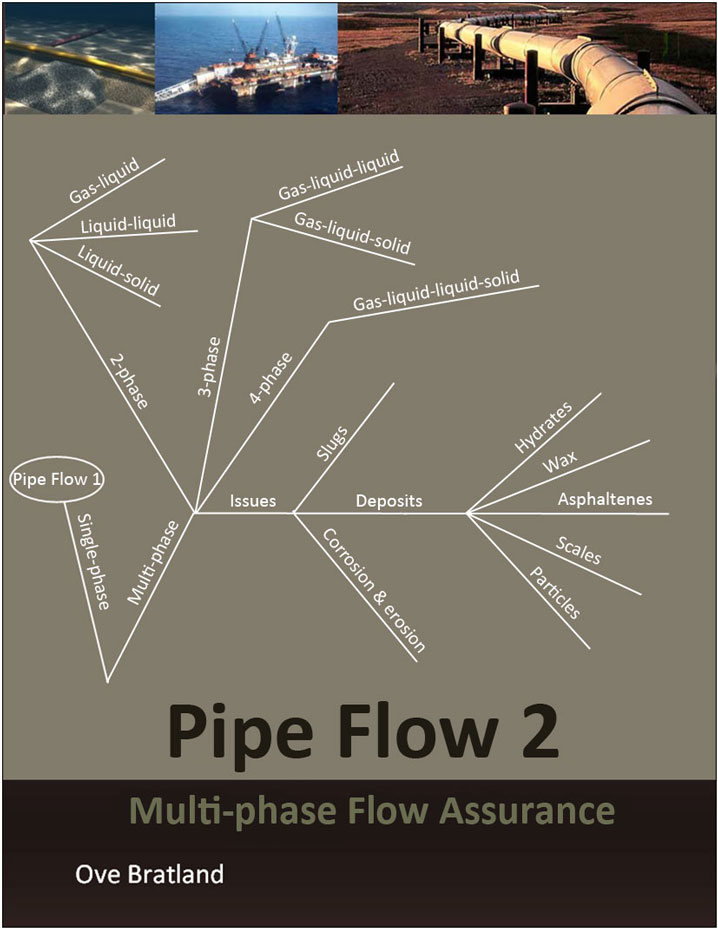 ]2[/h] Table of Contents Preface
  1 Introduction 1.1 Multi-phase flow assurance 1.1.1 General 1.1.2 Nuclear reactor multi-phase models 1.1.3 Multi-phase flow in the petroleum industry 1.2 Two-phase flow 1.2.1 Flow regimes in horizontal pipes 1.2.2 Slugging 1.2.3 Flow regimes in vertical pipes 1.2.4 Flow regime maps 1.2.5 Flow in concentric and eccentric annulus 1.3 Three and four-phase flow 1.3.1 Types of three-phase and quasi four-phase flow 1.3.2 Three-phase flow regimes 1.4 Typical flow assurance tasks 1.5 Some definitions 1.5.1 General 1.5.2 Volume fraction, holdup and water cut 1.5.3 Superficial velocity 1.5.4 Mixture velocity and density 1.5.5 Various sorts of pipes 2 Conservation equations 2.1 Introduction 2.2 Mass conservation 2.2.1 Comparing single-phase and multi-phase mass conservation 2.2.2 Mass conservation for well mixed phases 2.3 Multi-phase momentum conservation 2.3.1 Main equations 2.3.2 Pressure differences between phases due to elevation differences 2.3.3 Summarizing the forces between phases 2.3.4 Comparing single- and multi-phase momentum conservation 2.4 Energy conservation 2.4.1 Comparing single-phase and multi-phase energy conservation 2.5 Mass transfer between phases with equal pressures 2.6 Comments on the conservation equations 2.6.1 Averaging 2.6.2 Closure relationships 3 Two-Fluid Model 3.1 Problem definition 3.2 Mass conservation 3.3 Momentum conservation 3.4 Gas and liquid pressure difference in stratified flow 3.5 Friction in stratified flow 3.6 Steady-state incompressible flow solution 3.6.1 The model 3.6.2 Solution method 3.7 Steady-state compressible flow solution 3.8 Fully transient simulation model 3.9 The drift-flux model 3.10 Ignoring inertia in the momentum equations 3.11 Incompressible transient model 4 Three-fluid model 4.1 General 4.2 Mass conservation 4.3 Momentum conservation 4.4 Energy equation 4.5 Fluid properties 5 Friction, deposition and entrainment 5.1 Friction between gas core and liquid film 5.1.1 General about friction 5.1.2 The friction model 5.1.3 The Darcy-Weisbach friction factor for the liquid film-gas interface 5.1.4 Friction between the liquid film and the wall 5.2 Droplet gas friction and dynamic response time 5.3 Droplet liquid friction forces 5.3.1 Introduction 5.3.2 Zaichik and Alipchenkov’s eddy-droplet interaction time model 5.3.3 Droplet-liquid film friction modeled as if the droplets were a continuum 5.4 Droplet deposition 5.5 Liquid film entrainment 5.6 Droplet size 5.6.1 Maximum stable droplet diameter due to average velocity difference 5.6.2 Maximum stable droplet diameter due to turbulence 5.6.3 Average droplet diameter 6 Solving the two-phase three-fluid equations 6.1 Steady-state incompressible isothermal flow 6.2 Comparing with measurements 6.3 Steady-state compressible flow 6.4 Transient three-fluid two-phase annular flow model 7 Gas-liquid slug flow 7.1 Slug mechanisms 7.2 Empirical slug period correlations 7.2.1 Slug frequency and slug length 7.2.2 Slug fractions 7.2.3 Taylor-bubble and slug bubble velocities 7.3 Slug train friction 7.4 Dynamic slug simulation 8 Including boiling and condensation 8.1 Extending the three-fluid two-phase model 8.2 Mass conservation 8.3 Momentum conservation 8.3.1 Main equations 8.3.2 Some comments on interface velocity 8.4 Energy equation 8.5 Pressure equation 8.6 Mass transfer from liquid (film and droplets) to gas 8.7 Slip between gas and droplets in annular flow 8.8 Droplet deposition in annular flow 8.8.1 The Wallis-correlation 8.8.2 The Oliemans, Pots, and Trope-correlation 8.8.3 The Ishii and Mishima-correlation 8.8.4 The Sawant, Ishii, and Mori-correlation 8.9 Dispersed bubble flow 8.10 Slug flow 9 Improved slug flow modeling 9.1 Introduction 9.2 Governing equations 9.3 Friction model 9.4 Slug bubble entrainment and release 9.4.1 Slug bubble velocity 9.4.2 Bubbles entering and leaving the liquid slug 9.4.3 Film and slug front/tail velocities 9.5 Model validity and results 10 Multi-phase flow heat exchange 10.1 Introduction 10.2 Classical, simplified mixture correlations 10.3 Improved correlations for all flow regimes in horizontal two-phase flow 10.4 Flow regime-dependent approximation for horizontal flow 10.5 Flow-regime dependent two-phase correlations for inclined pipes 10.6 Dispersed bubble flow 10.7 Stratified flow 10.8 Slug flow 11 Flow regime determination 11.1 The Beggs & Brill flow regime map 11.2 The Taitel & Duckler horizontal flow model 11.3 Flow regimes in vertical flow 11.3.1 Bubble to slug transition 11.3.2 Transition to dispersed-bubble flow 11.3.3 Slug to churn transition 11.3.4 Transition to annular flow 11.4 Flow regimes in inclined pipes 11.4.1 Bubble to slug transition 11.4.2 Transition to dispersed-bubble flow 11.4.3 Intermittent to annular transition 11.4.4 Slug to churn transition 11.4.5 Downward inclination 11.5 The minimum-slip flow regime criterion 12 Numerical solution methods 12.1 Some essentials about numerical methods 12.1.1 Some problems with higher order methods 12.1.2 Using Taylor-expansion to approximate 12.1.3 Truncation error, order, stability, consistency, and convergence 12.1.4 Implicit integration methods 12.1.5 Combining explicit and implicit methods 12.2 Some essentials about hyperbolic equations 12.3 Solving systems of hyperbolic equations 12.3.1 Flux-vector splitting 12.3.2 Lax-Friedrich’s method 12.4 Hyperbolic equations with source terms 12.5 Selecting discretization methods 12.6 Improved TR-BDF2 method 12.7 Semi-implicit methods 12.8 Newton-Rapson and Newton-Krylov iteration 12.8.1 The problem with Newton-Rapson iteration for large systems 12.8.2 Creating the Jacobian with fewer function calls 12.8.3 Some problems with Newton-iteration 12.8.4 Avoiding the Jacobian using Newton-Krylov iteration 13 Two-phase liquid-liquid flow 13.1 General 13.2 Emulsion viscosity 13.3 Phase inversion criteria 13.4 Stratified flow friction modeling 14 Two-phase liquid-solid flow 14.1 General about liquid-solid flow 14.2 The building up of solids in the pipeline 14.3 Minimum transport velocity 15 Three-phase gas-liquid-liquid flow 15.1 Introduction 15.2 Main equations 15.3 Three-layer stratified flow 15.4 Incompressible steady-state slug flow model 15.5 Combining the different flow regimes into a unified model 16 Three-phase gas-liquid-solid flow 16.1 Introduction 16.2 Models and correlations 17 Fluid properties 17.1 General 17.2 Equations of state 17.3 Other properties for equation closure 17.3.1 Enthalpy 17.3.2 Internal energy 17.3.3 Entropy 17.3.4 Heat capacity 17.3.5 Joule-Thompson coefficient 17.3.6 Speed of sound 17.3.7 Viscosity and thermal conductivity 17.3.8 Interfacial surface tension 18 Deposits and pipe damage 18.1 Introduction 18.2 Hydrates 18.2.1 General 18.2.2 Hydrate blockage prevention 18.2.3 Hydrate formation rate prediction 18.3 Waxes 18.4 Asphaltenes 18.5 Scales 18.6 Corrosion, erosion, and cavitation 18.6.1 General 18.6.2 Corrosion simulation models 18.7 Heavy oil and emulsions 19 Various subjects 19.1 Multi-phase flowmeters and flow estimators 19.2 Gas lift 19.2.1 General 19.2.2 Oil & water-producing well with gas lift: Simulation example 19.3 Slug catchers Suggested reading References Nomenclature
  © 2010 Dr. Ove Bratland
  Recent Threads

 Random Threads
vBulletin Message