[table]
[TR]
[TD] Drilling: Calculation of properties for casing strings
[/TD]
[/TR]
[/table]
[table]
[TR]
[TD] [table]
[TR]
[TD] Reference is made to figures and tables in
"Applied Drilling Engineering, by Bourgoyne et al, Chapter 7 Casing Design, pages 302 to 325.
Given below is a quick "cheat sheet" of casing string properties, without "effects" (effect of bending, effect of hydrogen sulfide, effect of field handling). Also, the equations below do not provide information on design of casing program.
[/TD]
[/TR]
[/table]
(1) Body yield strength of casing

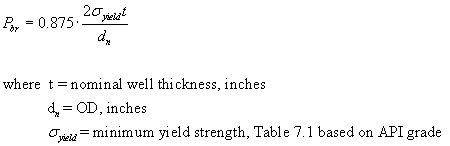
(2) Burst Pressure
Barlow's equation with 87.5% added for minimum allowable wall thickness:
(3) API Joint Strength formula for tensional force
Joint strength depends on the type of connector. See casing properties table (Table and Figure 7.10 for API formulas). Minimum yield strength will depend on casing grade. Connector types are round thread, buttress thread and extreme line.
(4) Collapse Pressure with zero axial load
The collapse pressure rating can be calculated as:
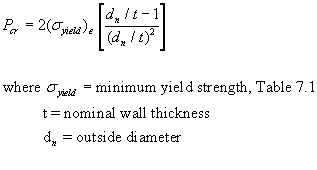
The above equation is called "yield strength" collapse. It has been shown experimentally that yield strength collapse occurs only for the lower range of  applicable for oil well casing.
At the upper end of use the following equation, appropriate for elastic collapse range (Table 7.5, page 309)
[table]
[TR]
[TD="width: 29%"]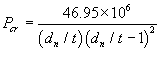 [/TD]
[/TD]
[TD="width: 71%"]Table 7.5 shows range of dn/t for the collapse pressure regions when axial pressure is zero. For example, for H-40 and dn/t < 16.4, we are in the yield strength collapse region, and above 42.6 we are in elastic collapse. Equations 7.6a and 7.6b, page 310 cover the range in between, which are plastic collapse and transitional collapse. [/TD]
[/TR]
[/table]
(5) Collapse Pressure with combined stress under the assumption that mode of failure is yield strength collapse.
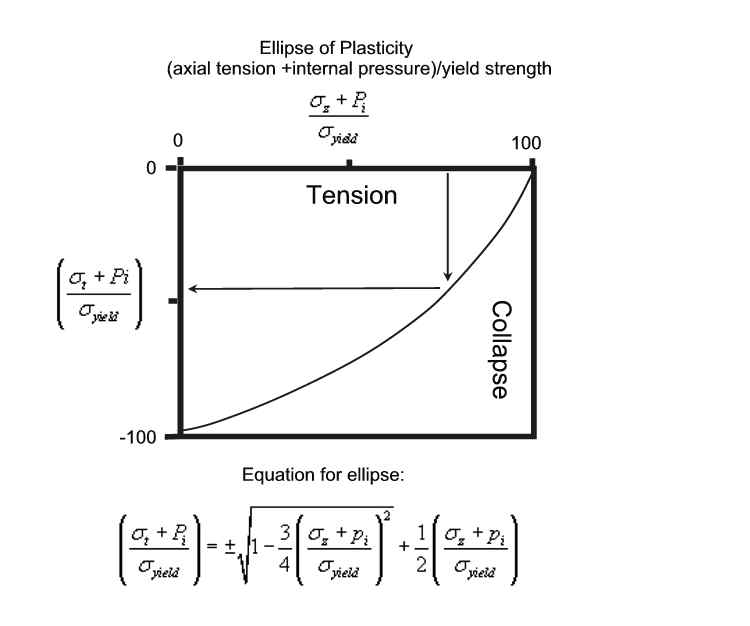
These calculations depend on the ellipse of plasticity, Figure 7.13, and can not be applied unless the yield strength mode of failure is known to be valid. So, under this assumption, we proceed:
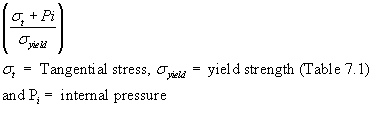
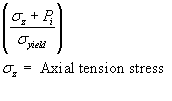
The ellipse of plasticity relates these two ratios:
[table]
[TR]
[TD="width: 55%"] Tangential stress ratio (Equation 1)
[/TD]
[TD="width: 45%"] Axial tension ratio (Equation 2)
[/TR]
[/table]
[table]
[TR]
[TD="width: 93%"] For in-service conditions with axial tension stress and internal pressure, we do the following:
- Calculate axial tension ratio (Eqn 1 as shown above) using as the yield stress the minimum yield stress in Table 7.1.
- Read off the Y axis, the Tangential stress ratio (a negative number)
- Since we know both yield strength and Pi, we calculate Pe.
[/TD]
[TD="width: 7%"] [/TD]
[/TR]
[/table]
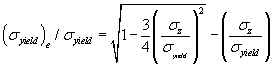
(6) API Recommended Procedure for effective yield strength:
In addition to the above, the effects of bending, hydrogen sulfide and field handling are also factors in casing design, as reviewed in Chapter 7.
Miscellaneous:
From Bourgoyne et al, Applied Drilling
Table 7.1 Maximum Yield strengh by API Grade (H-40, J-55, ...) Page 302 at top. Table 7.2 covers non API grades
Table 7.5: Ranges of dn/t for Collapse Pressure Regions when axial stress is zero (usually we assume yield strength collapse).
Table 7.6 Minimum performance of tubing given OD, Nominal weight and API Grade
Figure 7.13 (same as equation 7.11): Ellipse of plasticity
In casing design, we are concerned only with detrimental effects,
Axial tension causes detrimental effect on collapse pressure rating
Axial compression causes detrimental effect on burst pressure rating.
[/TD]
[/TR]
[/table]


 Reply With Quote


Bookmarks