


Low pressure at the suction side of a pump can encounter the fluid to start boiling with
- reduced efficiency
- cavitation
- damage
of the pump as a result. Boiling starts when the pressure in the liquid is reduced to the vapor pressure of the fluid at the actual temperature.
To characterize the potential for boiling and cavitation, the difference between the total head on the suction side of the pump - close to the impeller, and the liquid vapor pressure at the actual temperature, can be used.
[h=Suction Head]3[/h] Based on the Energy Equation - the suction head in the fluid close to the impeller can be expressed as the sum of the static and the velocity head:
hs = ps / γ + vs2 / 2 g (1)[h=Liquids Vapor Head]3[/h] The liquids vapor head at the actual temperature can be expressed as:
where
hs = suction head close to the impeller
ps = static pressure in the fluid close to the impeller
γ = specific weight of the fluid
vs = velocity of fluid
g =[link Point to another website Only the registered members can access]
hv = pv / γ (2)Note! The vapor pressure in a fluid depends on temperature. Water, our most common fluid, starts boiling at 20 oC if the absolute pressure in the fluid is 2.3 kN/m2. For an absolute pressure of 47.5 kN/m2, the water starts boiling at 80 oC. At an absolute pressure of 101.3 kN/m2 (normal atmosphere), the boiling starts at 100 oC.
where
hv = vapor head
pv = vapor pressure
[h=Net Positive Suction Head - NPSH]3[/h] The Net Positive Suction Head - NPSH - can be expressed as the difference between the Suction Head and the Liquids Vapor Head and expressed like
NPSH = hs - hv (3)[h=Available NPSH - NPSHa]3[/h] The Net Positive Suction Head made available the suction system for the pump is often named NPSHa. The NPSHa can be determined during design and construction, or determined experimentally from the actual physical system.
or, by combining (1) and (2)
NPSH = ps / γ + vs2 / 2 g - pv / γ (3b)
The available NPSHa can be calculated with the Energy Equation. For a common application - where the pump lifts a fluid from an open tank at one level to an other, the energy or head at the surface of the tank is the same as the energy or head before the pump impeller and can be expressed as:
h0 = hs + hl (4)In an open tank the head at surface can be expressed as:
where
h0 = head at surface
hs = head before the impeller
hl = head loss from the surface to impeller - major and minor loss in the suction pipe
h0 = p0 / γ = patm / γ (4b)For a closed pressurized tank the absolute static pressure inside the tank must be used.
The head before the impeller can be expressed as:
hs = ps / γ + vs2 / 2 g + he (4c)
wherehe = elevation from surface to pump - positive if pump is above the tank, negative if the pump is below the tankTransforming (4) with (4b) and (4c):
patm / γ = ps / γ + vs2 / 2 g + he + hl (4d)The head available before the impeller can be expressed as:
ps / γ + vs2 / 2 g = patm / γ - he - hl (4e)or as the available NPSHa:
NPSHa = patm / γ - he - hl - pv / γ (4f)


 Reply With Quote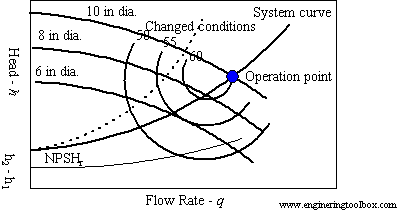


Bookmarks