No pump is perfect with 100% efficiency. The energy lost in friction and hydraulic losses are transformed to heat - heating up the fluid transported through the pump.
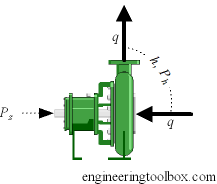
The temperature rise can be calculated as
dt = Ps (1 - μ) / cp q ρ (1)
where
dt = temperature rise in the pump (oC)
q = volume flow through the pump (m3/s)
Ps = brake power (kW)
cp = specific heat capacity of the fluid (kJ/kgoC)
μ = pump efficiency
ρ = fluid density (kg/m3)
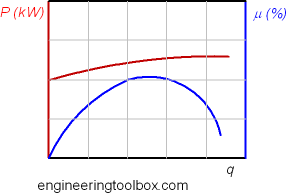
Typical relation between the centrifugal pump flow, efficiency and power consumption, is indicated in the figure below:
[h=Example - Temperature rise in water pump]3[/h] The temperature rise in a water pump working at normal conditions with flow 6 m3/h (0.0017 m3/s), brake power 0.11 kW and pump efficiency of 28% (0.28), can be calculated as
dt = (0.11 kW) (1 - 0.28) / (4.2 kJ/kgoC) (0.0017 m3/s) (1000 kg/m3)
= 0.011 oC
If the flow of the pump is reduced by throttling the discharge valve, the temperature rise through the pump will increase. If the flow is reduced to 2 m3/h (0.00056 m3/s), the brake power is slightly reduced to 0.095 kW and pump efficiency reduced to 15% (0.15), the temperature rise can be calculated as
dt = (0.095 kW) (1 - 0.15) / (4.2 kJ/kgoC) (0.00056 m3/s) (1000 kg/m3)
= 0.035 oC
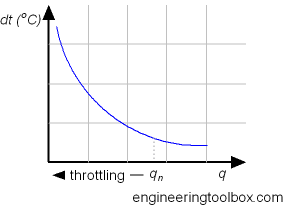
With the standard documentation provided by a manufacturer it should be possible to express the temperature rise as a function of volume flow as shown in the figure below:


 Reply With Quote

Bookmarks