


Examples of common residential water systems
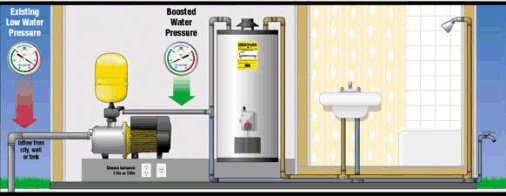
This next figure shows a typical small residential water system.The yellow tank is an accumulator.
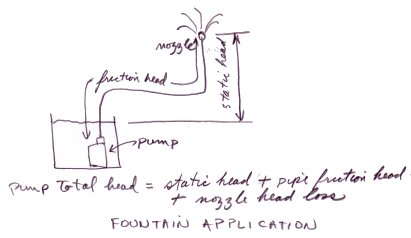
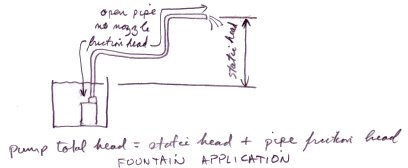
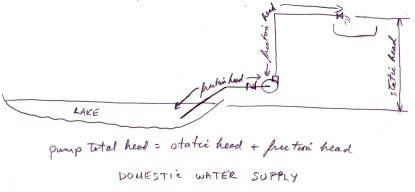
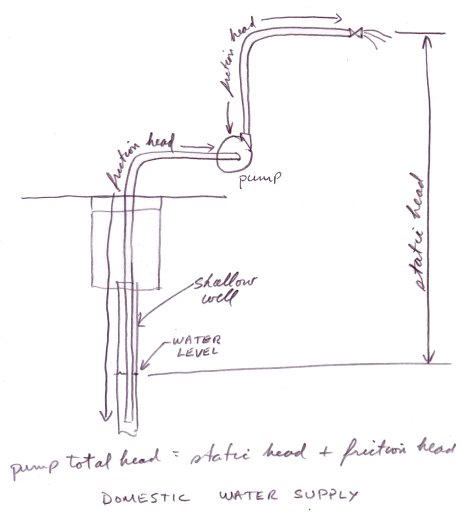
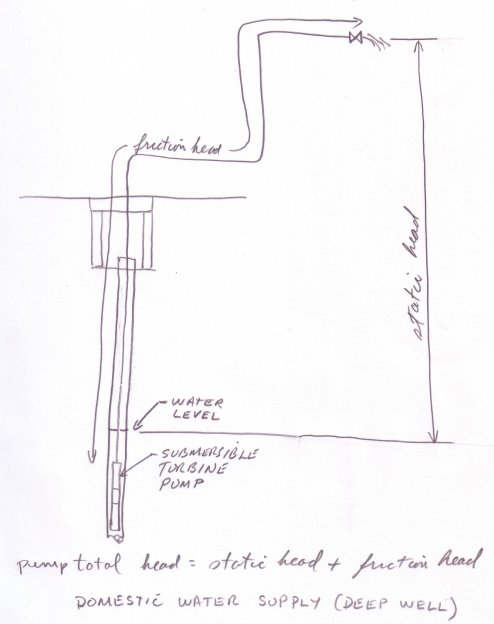
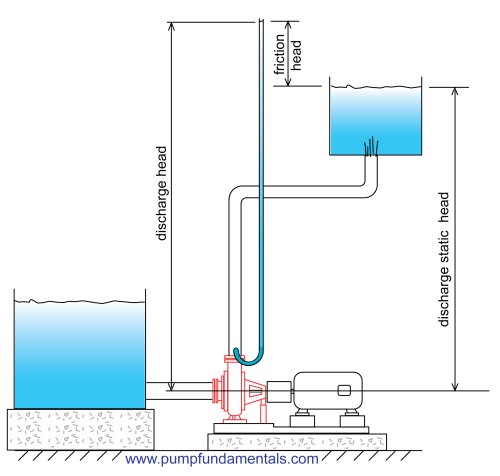
The following figures show various common water systems and indicates what the static head, the friction head and the pump total head.
This[link Point to another website Only the registered members can access]
Calculate the pump discharge pressure from the pump total head
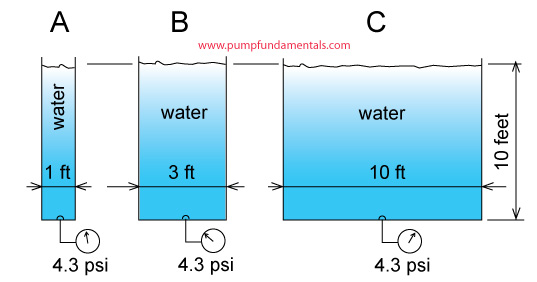
To calculate the pressure at the bottom of a pool, you need to know the height of the water above you. It doesn’t matter if it’s a pool or a lake, the height is what determines how much fluid weight is above and therefore the pressure.
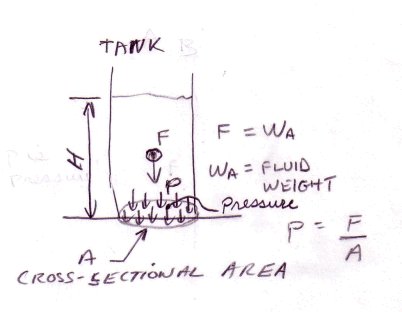
Pressure is equal to a force divided by a surface. It is often expressed in pounds per square inch or psi. The force is the weight of water. The density of water is 62.3 pounds per cubic foot.
The weight of water in tank A is the density times it’s volume.
The volume of the tank is the cross-sectional area A times the height H.
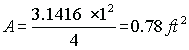
The cross-sectional area is pi times the diameter squared divided by 4.
The cross-sectional area of tank A is:
The volume V is A x H:
The weight of the water WA is:
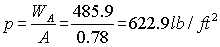
Therefore the pressure is:
This is the pressure in pounds per square feet, one more step is required to get the pressure in pounds per square inch or psi. There is 12 inches to a foot therefore there is 12x12 = 144 inches to a square foot.
The pressure p at the bottom of tank A in psi is:
If you do the calculation for tanks B and C you will find exactly the same result, the pressure at the bottom of all these tanks is 4.3 psi.
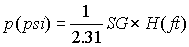
The general relationship for pressure vs. tank height is:
SG or specific gravity is another way of expressing density, it is the ratio of a fluid's density to that of water, so that water will have an SG =1. Denser liquids will have a value greater than 1 and lighter liquids a value less than 1. The usefulness of specific gravity is that it has no units since it is a comparative measure of density or a ratio of densities therefore specific gravity will have the same value no matter what system of units we are using, Imperial or metric
For those of you who would like to see how this general relationship is found go to Appendix E in the[link Point to another website Only the registered members can access]
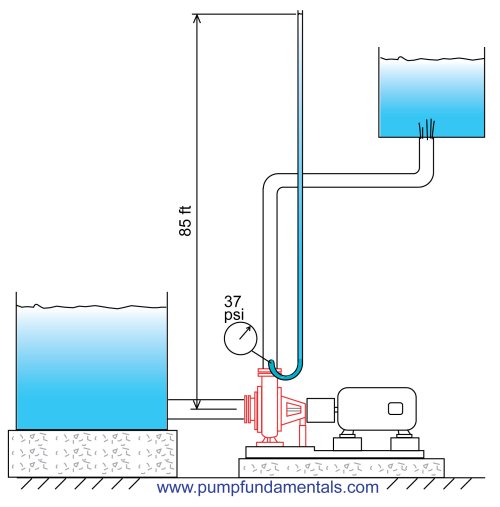
We can measure head at the discharge side of the pump by connecting a tube and measuring the height of liquid in the tube.Since the tube is really only a narrow tank we can use the pressure vs. tank height equation
to determine the discharge pressure. Alternatively, if we put a pressure gauge at the pump discharge, we can then calculate the discharge head.
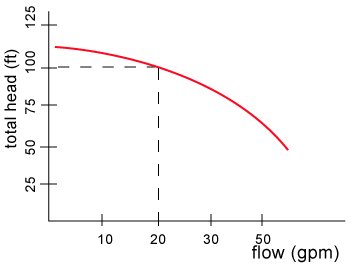
We can calculate the discharge pressure of the pump based on the total head which we get from the characteristic curve of the pump. This calculation is useful if you want to troubleshoot your pump or verify if it is producing the amount of pressure energy that the manufacturer says it will at your operating flow rate.
Figure 37
For example if the characteristic curve of the pump is as shown in Figure 39 and the flow in the system is 20 gpm. The total head is then 100 feet.
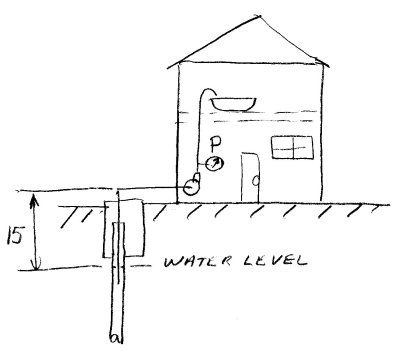
The installation is as shown in Figure 37, a domestic water system that takes its water from a shallow well 15 feet lower than the pump suction.
The pump will have to generate lift to get the water up to its suction connection. This means that the pressure will be negative (relative to atmosphere) at the pump suction.
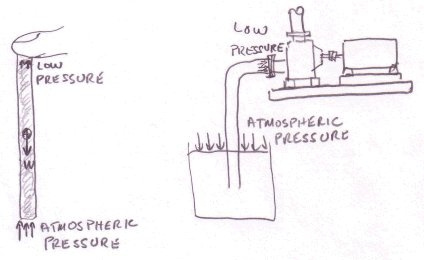
Why is this pressure less than atmospheric pressure or low? If you take a straw, fill it with water, cover one end with your fingertip and turn it upside down you will notice that the liquid does not come out of the straw, try it!. The liquid is pulled downward by gravity and creates a low pressure under your fingertip. The liquid is maintained in balance because the low pressure and the weight of the liquid is exactly balanced by the force of atmospheric pressure that is directed upwards.
The same phenomenon occurs in the pump suction which is pulling up liquid from a low source. Like in the straw, the pressure close to the pump suction connection must be low for the liquid to be supported.
To calculate the discharge head, we determine the total head from the characteristic curve and subtract that value from the pressure head at the suction, this gives the pressure head at the discharge which we then convert to pressure.
We know that the pump must generate 15 feet of lift at the pump suction, lift is negative static head. It should in fact be slightly more than 15 feet because a higher suction lift will be required due to friction. But let’s assume that the pipe is generously sized and that the friction loss is small.
Figure 39
TOTAL HEAD = 100 = HD - HS
or
HD = 100 + HS
The total head is equal to the difference between the pressure head at the discharge HD and the pressure head at the suction HS. HS is equal to –15 feet because it is a lift therefore:
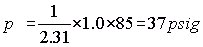
HD = 100 + (-15) = 85 feet
The discharge pressure will be:
Now you can check your pump to see if the measured discharge pressure matches the prediction. If not, there may be something wrong with the pump.
Note: you must be careful where you locate the pressure gauge, if it is much higher than the pump suction, say higher than 2 feet, you will read less pressure than actually is there at the pump. Also the difference in velocity head of the pump discharge vs. the suction should be accounted for but this is typically small.






 Reply With Quote

Bookmarks