


The Best of the Internet
Centrifugal Pumps and Viscosity
by
, 07-26-2011 at 10:52 PM (805 Views)
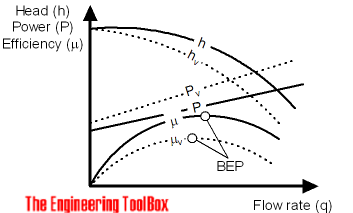
When a viscous fluid is handled by a centrifugal pump
- brake horsepower requirement increases
- the head generated is reduced
- capacity is reduced
- efficiency of pump is reduced and the Best Efficiency Point - BEP - is moved
The head, flow and capacity at other viscosities than used in the original documentation can be modifying with coefficients.
[h=Flow]3[/h]qv= cq q (1)[h=Head]3[/h]
where
qv = flow compensated for viscosity (m3/h, gpm)
cq = viscosity flow coefficient
q = original flow according pump curve (m3/h, gpm)hv= ch h (2)[h=Efficiency]3[/h]
where
hv = head compensated for viscosity (m, ft)
ch = viscosity head coefficient
h = original head according pump curve (m, ft)μv= cμ μ (3)[h=Power - SI units]3[/h]
where
μv = effciency compensated for viscosity
cμ = viscosity efficiency coefficient
μ = original efficiency according pump curvePv= qv hv ρv g / (3.6 106 μv) (4)[h=Power - Imperial units]3[/h]
where
Pv = power compensated for viscosity (kW)
ρv = density of viscous fluid (kg/m3)
g = acceleration of gravity (9.81 m/s2)Pv= qv hv SG / (3960 μv) (5)
where
Pv = power compensated for viscosity (bhp)
SG = specific gravity of viscous fluid


Tags:
None

- Categories
- Uncategorized
 Email Blog Entry
 Go to Profile
 Mark as Read
