<

View RSS Feed

Uncategorized

Entries with no category

  1. CONTROLLING VESSELS and TANKS

    CONTROLLING VESSELS and TANKS © Walter ********, P. Eng., 2001 Sept 07. walter(at)********(dot)ca


    First published in Hydrocarbon Processing , July 1995.


    INTRODUCTION. It would seem that controlling a vessel should be a very simple matter -- They don't really do anything! But then, if they didn't do anything why are there so many of them? And why do they have so many different names? Going through a typical set of Piping and Instrumentation Diagrams (P&IDs) I see the following vessels:
    · Degassing Drum · Gas Separator · Storage Tank
    · Feed Flash Drum · Reflux Accumulator · Day Tank
    · Surge Drum · Suction Scrubber · Slug Catcher
    · Lube Oil Separator · Head Tank · Deaerator
    Although each of these is essentially a simple vessel or tank without any special internal structure, each serves a different purpose. Once it is clear what the purpose of a piece of equipment is, and how it functions, it will also be clear how to control and protect it. Different purposes require different controls.
    SURGE TANKS. The most common function of a vessel or tank is to match two flows that are not identical in time but are expected to average out over the long run. Take a feed surge drum, for example. Flow into the unit is more or less steady but is subject to interruption. The flow to the processing unit should be as constant as possible, avoiding sudden change. Nevertheless, it, too, may be subject to interruption due to downstream conditions.
    The purpose of the surge drum is to maintain sufficient inventory to feed the process and to maintain sufficient void capacity to continue receiving feed as it arrives. Clearly the tank must be large enough to accommodate any normal discrepancies between input and output over a reasonable period of time. Between the upper and lower bound, the exact value of the level ...
    Categories
    Uncategorized
  2. Centrifugal Pumps and Viscosity

    When a viscous fluid is handled by a centrifugal pump


    • brake horsepower requirement increases
    • the head generated is reduced
    • capacity is reduced
    • efficiency of pump is reduced and the Best Efficiency Point - BEP - is moved
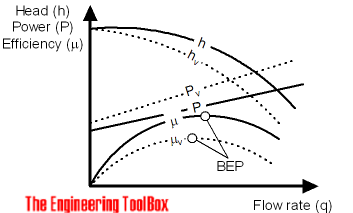

    The head, flow and capacity at other viscosities than used in the original documentation can be modifying with coefficients.
    [h=Flow]3[/h]
    qv= cq q (1)
    where
    qv = flow compensated for viscosity (m3/h, gpm)
    cq = viscosity flow coefficient
    q = original flow according pump curve (m3/h, gpm)
    [h=Head]3[/h]
    hv= ch h (2)
    where
    hv = head compensated for viscosity (m, ft)
    ch = viscosity head coefficient
    h = original head according pump curve (m, ft)
    [h=Efficiency]3[/h]
    μv= cμ μ (3)
    where
    μv = effciency compensated for viscosity
    cμ = viscosity efficiency coefficient
    μ = original efficiency according pump curve
    [h=Power - SI units]3[/h]
    Pv= qv hv ρv g / (3.6 106 μv) (4)
    where
    Pv = power compensated for viscosity (kW)
    ρv = density of viscous fluid (kg/m3)
    g = acceleration of gravity (9.81 m/s2)
    [h=Power - Imperial units]3[/h]
    Pv= qv hv SG / (3960 μv) (5)
    where
    Pv = power compensated for viscosity (bhp)
    SG = specific gravity of viscous fluid
    Categories
    Uncategorized
1 2 3 4 5 6 7 8 9 10 11 12 13 14 15 16 17 18 19 20 21 22 23 24 25 26 27 28 29 30 31 32 33 34 35 36 37 38 39 40